01
Context
First hands-on computing project done in a team of three, combining programming, electronics, and physical fabrication. Carried out in the second year of the preparatory cycle at ENSIM, the brief required an Arduino-compatible board, a physical interactive object, and a fabricated enclosure to house it. The team chose to turn a strategy game inspired by a TV series into an electronic board game for 2 to 6 players.
02
Game rules
Each round, every player secretly picks a number. The system computes the average of all picks, multiplies it by 0.8, and declares the closest player the round’s winner.
- each player picks a number
- the system computes the average of all picks
- the average is multiplied by 0.8
- the closest player wins the round
- the others lose a life point
- progressive elimination down to a last player
03
Interactive object
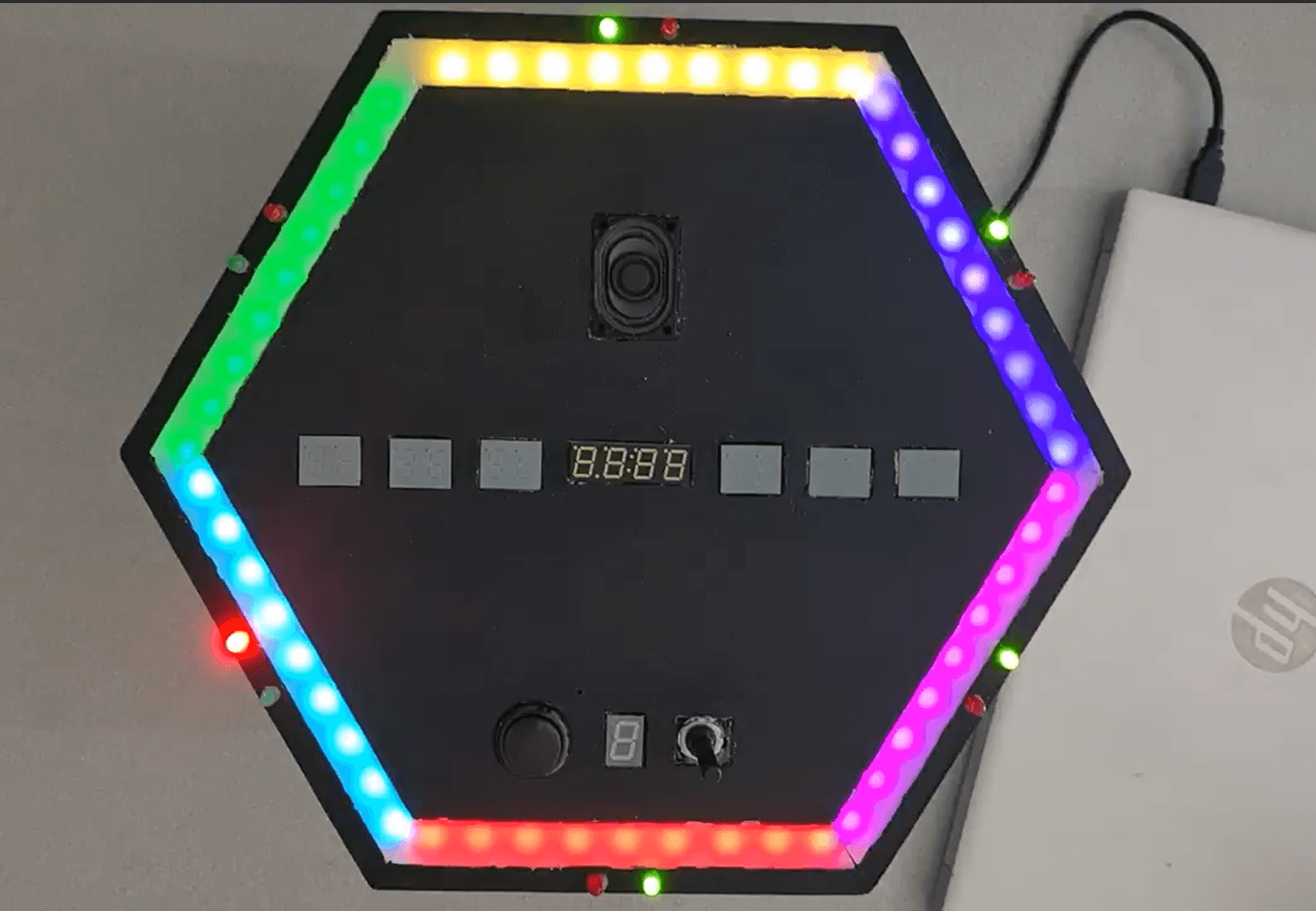
The enclosure takes the form of a hexagonal prism. Each side face corresponds to a player and integrates a matrix keypad, a 7-segment display for life points, and status LEDs. The top face groups the shared elements: displays for the chosen numbers and the computed result, a potentiometer to select the number of players, a confirm button, a speaker, and a peripheral LED strip.
04
Electronics and programming
The system runs on an Arduino Mega-compatible board, programmed in C/C++ in the Arduino IDE. The project combines matrix keypads, an I2C bus, 7-segment displays driven by a 74HC595 shift register, LEDs and an addressable strip via FastLED, and an MP3 module connected to a speaker. The code separates input acquisition, output control, and game logic before orchestrating them in the main loop.
05
Design and fabrication
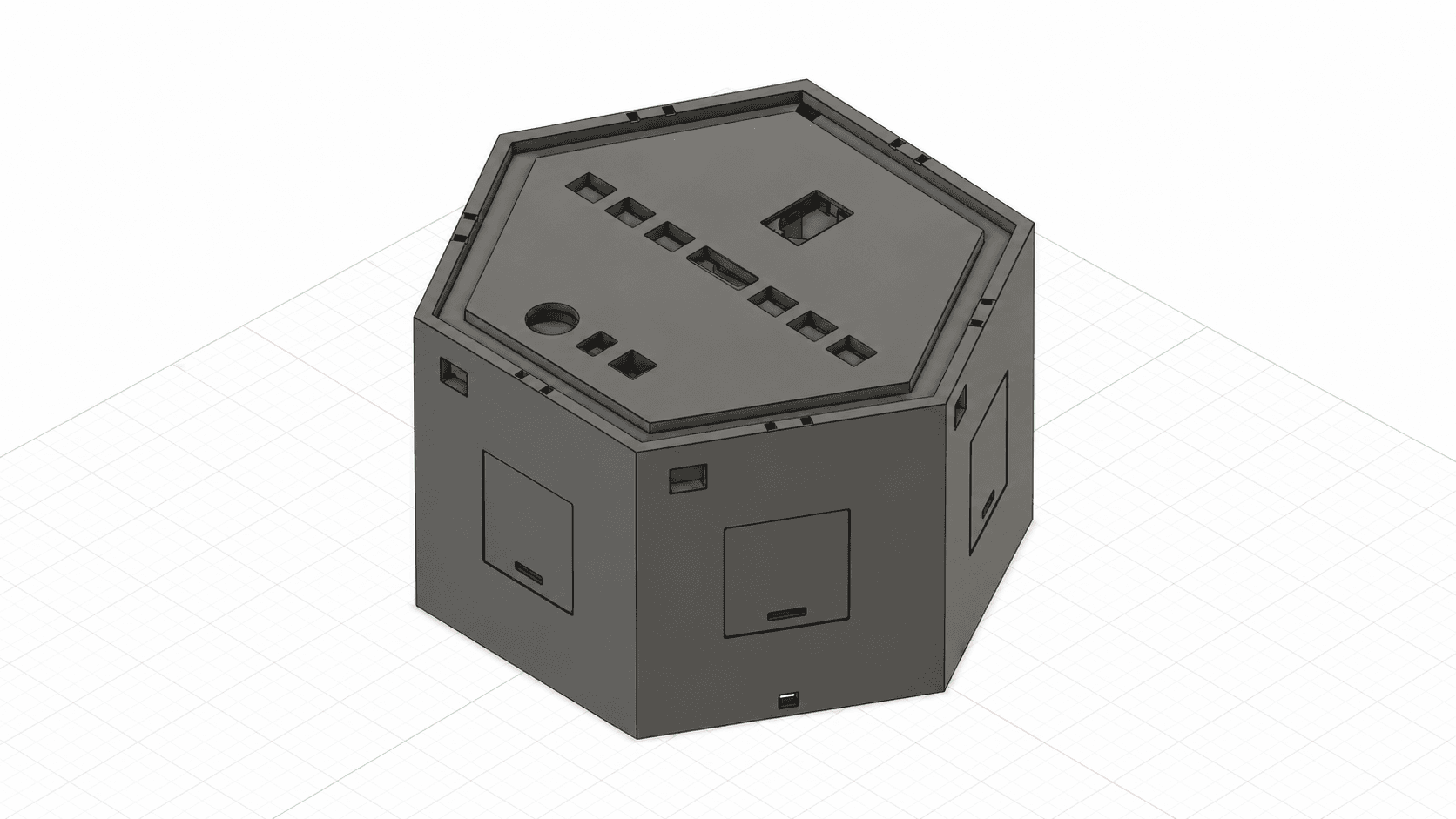
Before assembly, the enclosure was modeled in 3D to check dimensions, component layout, openings, and the integration of the keypads and displays. The final enclosure was then 3D-printed, painted, and assembled.
06
Staging and video presentation
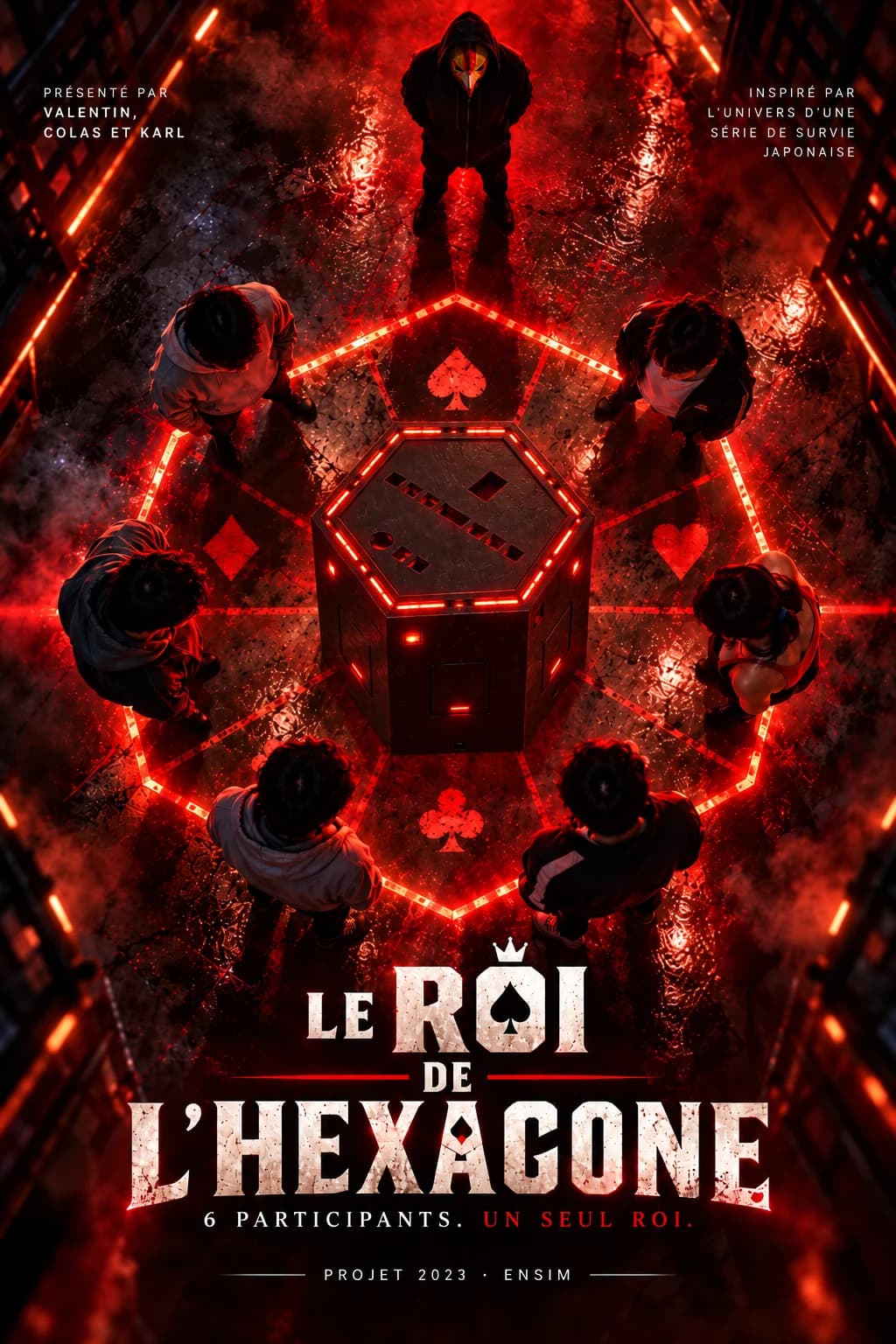
In addition to the finished game, a video presentation was expected to showcase the project. Since the concept was inspired by an episode of Alice in Borderland, the team chose to reuse its staging for the video: participants play the game, and, in the show’s universe, a player’s elimination also means their death. A masked character embodies this outside threat and follows the progress of the game. This staging made it possible to present the game in a narrative context consistent with its inspiration. The poster shown below was generated with an AI tool, based on the project’s visual elements and this artistic direction.
07
Testing and difficulties
Each component was progressively tested during assembly, with electrical continuity checks, before being integrated into the full system. The main difficulties involved the limited number of available pins, dense wiring, soldering in a tight space, and loose contacts. A trade-off was notably needed on the life-point displays to save pins.
08
Limits and hindsight
The prototype is still USB-powered only, with dense internal wiring prone to loose contacts. The code is functional but not well optimized, and electronics maintainability could be improved. These limits are also part of the project’s value: it was a first complete experience linking software, electronics, and the fabrication of a working interactive object.